Turkana Basin, Kenya
Since 2010 our team has been engaged in collaborative field research projects aimed at understanding human evolution during the Plio-Pleistocene.


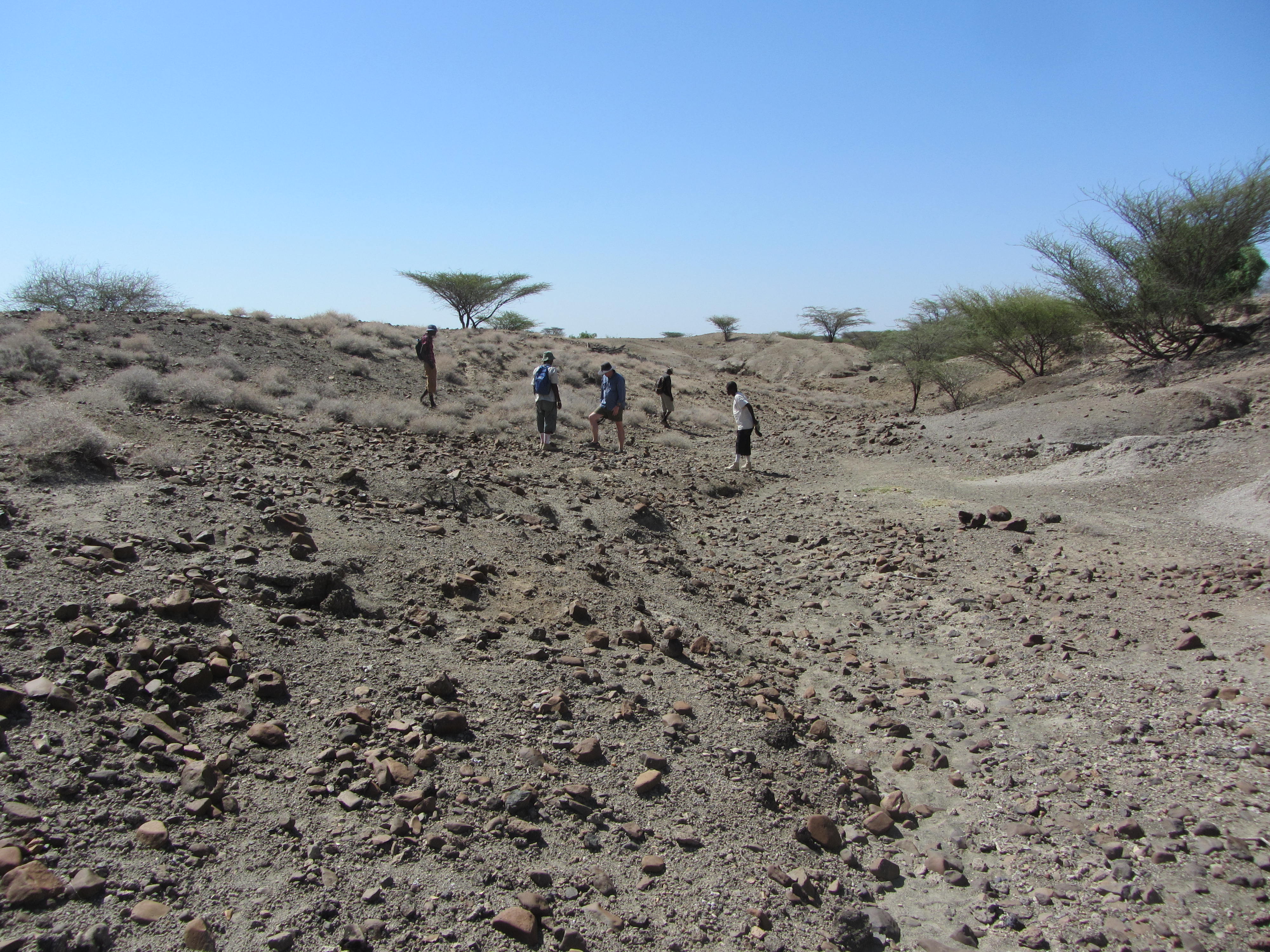
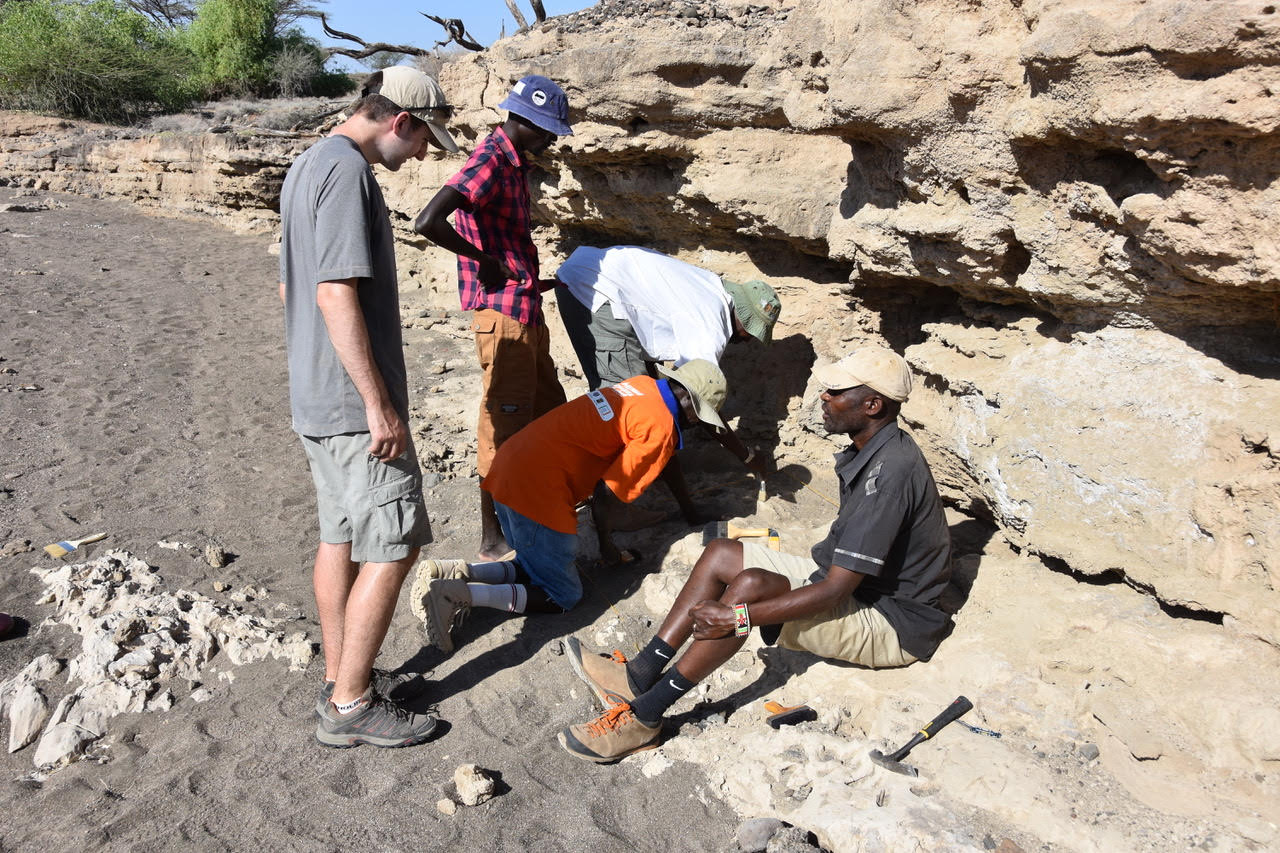
Research in the Turkana Basin, Kenya has involved the discovery and excavation of skeletal fossils and fossil footprints at more than 25 distinct localities, all dating to approximately 1.4-1.6 million years ago (Ma). Many of these sites preserve footprints of fossil hominins, and from these we have gained critical insights regarding hominin anatomy and locomotion, as well as social behavior. Further, the footprints of other animals have provided us with snapshots of hominin environments. This work involves a variety of collaborations including with the National Museums of Kenya, and the Turkana Basin Institute. Dr. Hatala’s fieldwork in this area has been funded by grants from the National Science Foundation (BCS-0924476, -1128170, -1232522, -1515054, -2335894, DGE-0801634, SMA-1409612), the Leakey Foundation, and the Wenner-Gren Foundation.
Recent grants:
2024-2029: “CAREER: Tracking the evolution of human locomotion through field, experimental, and computational analyses of fossil footprints.” National Science Foundation (PI: KG Hatala)
2018-2019: “Paleoecological investigation of 1.5 Ma footprint sites near Nariokotome, Kenya.” Leakey Foundation (PI: KG Hatala, co-PIs: NT Roach, AK Behrensmeyer)
Selected publications:
Hatala KG, Roach NT, Behrensmeyer AK, Falkingham PL, Gatesy SM, Williams-Hatala EM, Feibel CS, Dalacha I, Kirinya M, Linga E, Loki R, Longaye AA, Longaye M, Lonyericho E, Loyapan I, Nakudo N, Nyete C, Leakey LK. (2024) Footprint evidence for locomotor diversity and shared habitats among early Pleistocene hominins. Science 386, 1004-1010.
Hatala KG, Roach NT, Behrensmeyer AK. (2023) Fossil footprints and what they mean for hominin paleobiology. Evolutionary Anthropology 32, 39-53.
Hatala KG, Roach NT, Ostrofsky KR, Wunderlich RE, Dingwall HL, Villmoare BA, Green DJ, Braun DR, Harris JWK, Behrensmeyer AK, Richmond BG. (2017) Hominin track assemblages from Okote Member deposits near Ileret, Kenya and their implications for understanding fossil hominin paleobiology at 1.5 Ma. Journal of Human Evolution 112, 93-104.
Hatala KG, Roach NT, Ostrofsky K, Wunderlich RE, Dingwall HL, Villmoare BA, Green DJ, Harris JWK, Braun DR, Richmond BG. (2016) Footprints preserve direct evidence of group behavior and locomotion in Homo erectus. Scientific Reports 6, 28766.
Roach NT, Hatala KG, Ostrofsky K, Villmoare BA, Reeves JS, Du A, Braun DR, Harris JWK, Behrensmeyer AK, Richmond BG. (2016) Pleistocene footprints show intensive use of lake margin habitats by Homo erectus groups. Scientific Reports 6, 26374.
Engare Sero, Tanzania
From 2010-12, Dr. Hatala was part of the team excavating and analyzing late Pleistocene human footprints from Engare Sero, Tanzania.

The site preserves more than 400 hominin footprints dated to between about 12 and 10 thousand years ago. In addition to the typical insights related to anatomy and locomotion, the scale of this assemblage allows for a fascinating glimpse into the structure and behavior of the large group of humans who passed through this area thousands of years ago. While excavations of the site ceased in 2012, analyses are still ongoing. The project involves collaborations with the Tanzania Department of Antiquities, and researchers from Appalachian State University, the Smithsonian Institution, Lehman College, and other institutions. Dr. Hatala’s work at the site has been supported by the National Science Foundation (DGE-0801634) and the Evolving Earth Foundation.
Tour the site and explore interactive materials from the Smithsonian 3D Digitization Program here.
Selected publications:
Hatala KG, Harcourt-Smith WEH, Gordon AD, Zimmer BW, Richmond BG, Pobiner BL, Green DJ, Metallo A, Rossi V, Liutkus-Pierce CM. (2020) Snapshots of human anatomy, locomotion, and behavior from Late Pleistocene footprints at Engare Sero, Tanzania. Scientific Reports 10, 7740.
Liutkus-Pierce CM, Zimmer BW, Carmichael SK, McIntosh W, Deino A, Hewitt SM, McGinnis KJ, Brett J, Mana S, Deocampo D, Richmond BG, Hatala KG, Harcourt-Smith WEH, Pobiner BL, Metallo A, Rossi V. (2016) Radioisotopic age, formation, and preservation of late Pleistocene Homo sapiens footprints at Engare Sero, Tanzania. Palaeogeography, Palaeoclimatology, Palaeoecology 463, 68-82.
 Hatala Lab